Introduction
Applying to colleges in the United States is an exhilarating but also somewhat perplexing experience for college applicants. While a student has to take various factors into account while applying at a US university like its fee structure, accrediatation status, and research opportunities, application timelines aren’t much talked about. Two of the most common application timelines in the United States are Early Decision and Regular Decision. Therefore, it is vital for college applicants to know the difference between these two college application options in order to create a winning strategy for their college applications.
Many college applicants, particularly international applicants, are confused about which option to choose between Early Decision and Regular Decision in the United States. Both options have their own advantages and disadvantages.
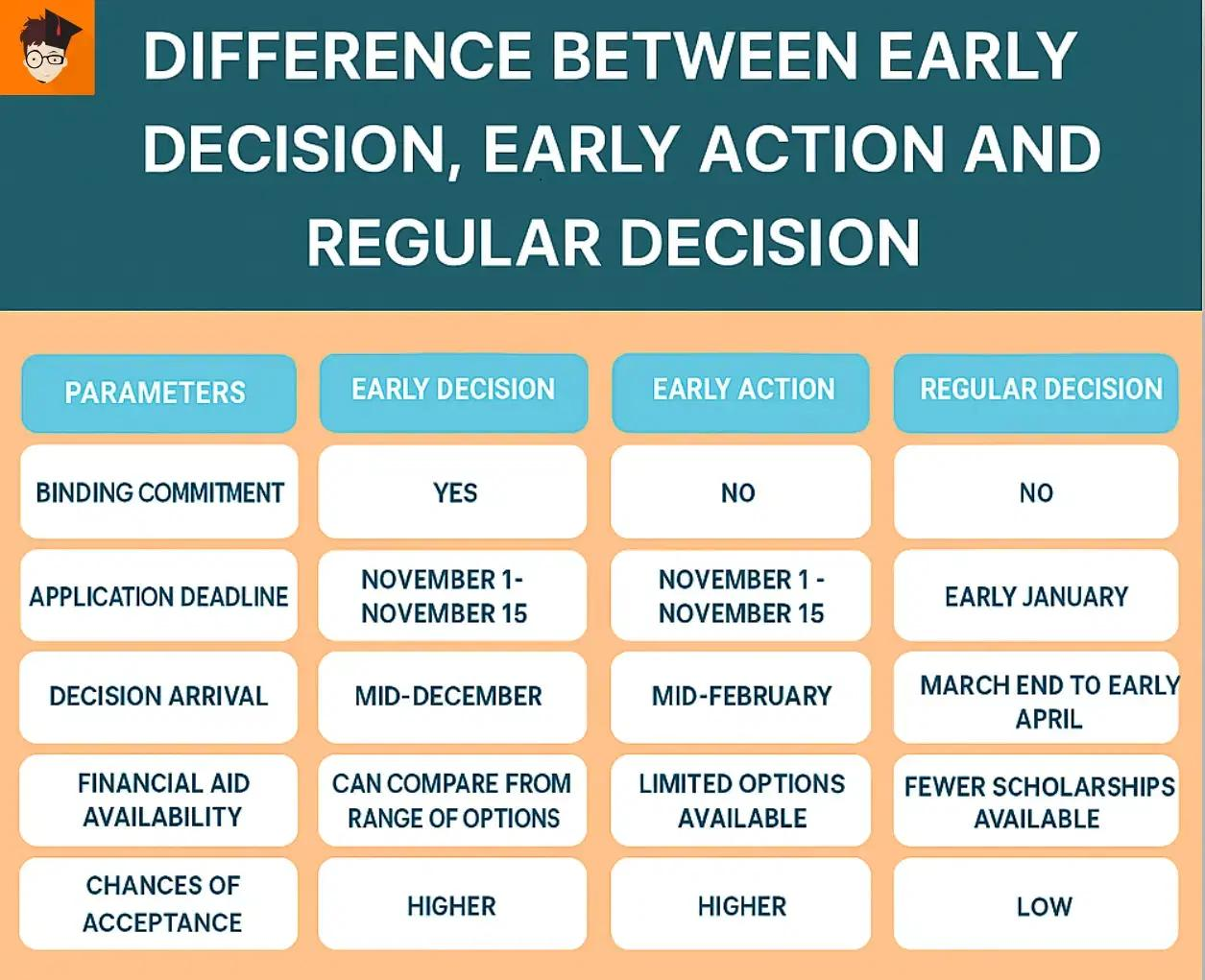
Understanding the US College Application Timeline
The US university admission process is holistic in nature. A university does not only look at a student’s academic credentials while making admissions decisions. Essays, recommendation letters, extracurricular activities, leadership experiences, community service, etc., are all taken into account while making admissions decisions. Therefore, it is recommended that a student start preparing for their US university applications well in advance.
The timing of US university applications is a critical component of the US university admissions process. Universities offer different application rounds to effectively manage their applicant pool and identify students who are highly interested in joining their university. Two types of application rounds are offered by US universities: Early Decision and Regular Decision.
The deadline for Early Decision applications is in early November, while decisions are announced in December. In contrast, the deadline for Regular Decision applications is in January, while decisions are announced in both March and April.
What Is Early Decision?
Early Decision is a particular application plan that is offered by many US universities. This application plan enables students to apply to the university ahead of the standard application deadline. However, it is essential to note that Early Decision is a binding application plan. This means that when a student is accepted through the Early Decision application plan, they are obligated to attend the university and must not apply to other schools.
The Early Decision application plan normally commences with the application deadline in early November. The university normally sends the decisions in mid-December. The students who are accepted through the Early Decision application plan receive an early confirmation of admission, which is less stressful and can enable them to concentrate on preparations to join the university.
One of the biggest advantages of Early Decision is that it shows a great deal of interest in the university. Admissions officials often appreciate students who demonstrate this kind of commitment to their school. In fact, the admissions rate for Early Decision students can sometimes be higher compared to Regular Decision students.
Another advantage is that students will know the results of their admissions decision earlier in the year. Instead of waiting months to find out the results of their decision, students will know in December.
Despite these advantages, there are some disadvantages of Early Decision as well. For one thing, since it is a binding decision, students will not be able to compare different universities. This can be a problem for students who are trying to compare different financial packages as well. In conclusion, it is only recommended for students who are sure of their first-choice university.
What Is Regular Decision?
Regular Decision is the most commonly used and accepted method for applying to colleges and other universities in the United States. Under this method, students apply to the university within the regular time frame set by the university. The regular time frame is usually in January.
The results of the Regular Decision method are usually announced in March and April. This allows the university enough time to review all the applications and make the right decision for the students.
The advantage of the Regular Decision method is the flexibility it provides to the students. Under this method, students can apply to as many universities as they want and wait until all the results are announced before they make the decision.
The advantage of the Regular Decision method is the time it provides to the students. Students can use the extra time to improve their performance in school and other activities.
However, the disadvantage of the Regular Decision method is the competition it provides. Under this method, students have to wait longer for the results. This creates uncertainty in the minds of the students at the end of the school year.
Early Decision vs. Regular Decision: Main Differences
In the US, when contrasting Early Decision and Regular Decision, the main difference lies in the fact that students are expected to commit to the university if they are accepted into the Early Decision program. In contrast, in the Regular Decision program, students can apply to and accept offers from more than one university.
In addition, the chances of admission for students vary slightly between the two types of decision plans. For example, universities might accept more students under the Early Decision program since they are eager to attend the university; however, the exact figures vary from university to university.
Another factor is the consideration of financial aid, and this is also a consideration for Early Decision applicants, meaning that they cannot compare financial aid offers from other schools since, in accepting Early Decision, the applicant is already accepting the offer, unlike Regular Decision applicants, who can compare financial aid offers from several schools.
Another consideration is planning and stress, since Early Decision can give applicants early assurance and relief. In contrast, Regular Decision can give applicants enough time to plan, albeit with the stress of waiting for the results.
When Should Students Use the Early Decision Option?
Students can reap the benefits of the Early Decision option when they have already identified the university they want to join. A student can be sure that the university they want to join is the best when they have researched the university and visited it.
Students with good grades can also take the Early Decision option. Students with good grades and test scores can reap the benefits of the Early Decision option.
Students can also consider the financial aspect when using the Early Decision option. Since the Early Decision option is binding, students must be prepared to pay the tuition fee when they choose the Early Decision option.
When Regular Decision May Be the Better Choice
Regular Decision may be the better option for students who need flexibility in their college choices. If you are still trying to figure out which colleges are best for you, then Regular Decision may be your best option.
You may also need extra time to strengthen your college applications. If you need extra time to improve your grades or to seek more leadership opportunities, then Regular Decision may be your best option.
Financial aid is also another factor to consider when choosing between Early Decision and Regular Decision. If you are receiving scholarships from different colleges, then Regular Decision may be your best option.
Strategic Tips for US College Applicants
A good starting point in creating a winning strategy begins with early research. Students are encouraged to begin researching potential colleges during their junior year of high school to ensure they find a school that meets their interests.
Preparing the application materials ahead of time is a crucial part of a winning strategy. Students are encouraged to prepare early to avoid last-minute stress, as personal essays, recommendation letters, and transcripts all require early planning.
Understanding the unique admissions policies of each college is a crucial part of a winning strategy. In addition to Early Decision and Regular Decision, some colleges offer Early Action, which allows students to apply early but not make a binding contract.
Finally, students are encouraged to apply to a range of colleges, known as a balanced college list, consisting of both reach, match, and safety schools, as this increases the chances of receiving multiple college admissions offers.
Common Mistakes Students Should Avoid
One of the most common mistakes that applicants should avoid is applying for Early Decision without conducting proper research. Since it is a binding agreement, it is vital for applicants to be 100% sure of their decision before applying.
Another common mistake that applicants should avoid is failing to conduct proper research regarding the financial costs associated with different universities. The cost of living at different universities may vary significantly.
Lastly, rushing to finish the application is another common mistake that applicants should avoid. The essays, recommendation letters, and extracurricular activities all contribute significantly to the holistic admissions process.
Conclusion
The decision between Early Decision vs. Regular Decision in US colleges is a critical one in the student’s application process. While Early Decision gives students a competitive edge in being accepted earlier by a university, it requires them to commit to attending the university if they are accepted. On the contrary, Regular Decision gives students more freedom to compare different universities and financial aid packages before making a decision.
The choice between Early Decision vs. Regular Decision depends on a student’s academic preparedness, financial status, and confidence in their chosen university. By carefully planning their application strategy, students can make a decision that is right for them.
By learning how these strategies can be used in US colleges, students can be more confident in their application strategy and be more likely to be accepted by a university that meets their needs and goals.
Contact Us
Contact us for a free consultation for student or visitor visas. Our immigration experts are ready to assist you.