The Move that Altered Everything
Visualize two classes that highlight the rise of critical thinking in Western education. The first one consists of students who quietly memorize definitions from their books to repeat them on the test. The second group of people discusses different topics, tries to solve practical problems, and even dares to doubt what they read in their textbooks. It describes a significant transition that happened in the world of education over many years. In the past, Western education was associated with memorization of a great deal of information, but nowadays, the new methods are preferred by educators and teachers.
This transition did not take place suddenly. For a long period of time, rote learning was recognized as an essential part of successful studies. However, as economies developed, people needed innovators who could find solutions and develop new approaches to different problems.
This paper is devoted to the discussion of the transition from memorization to critical thinking in Western education.
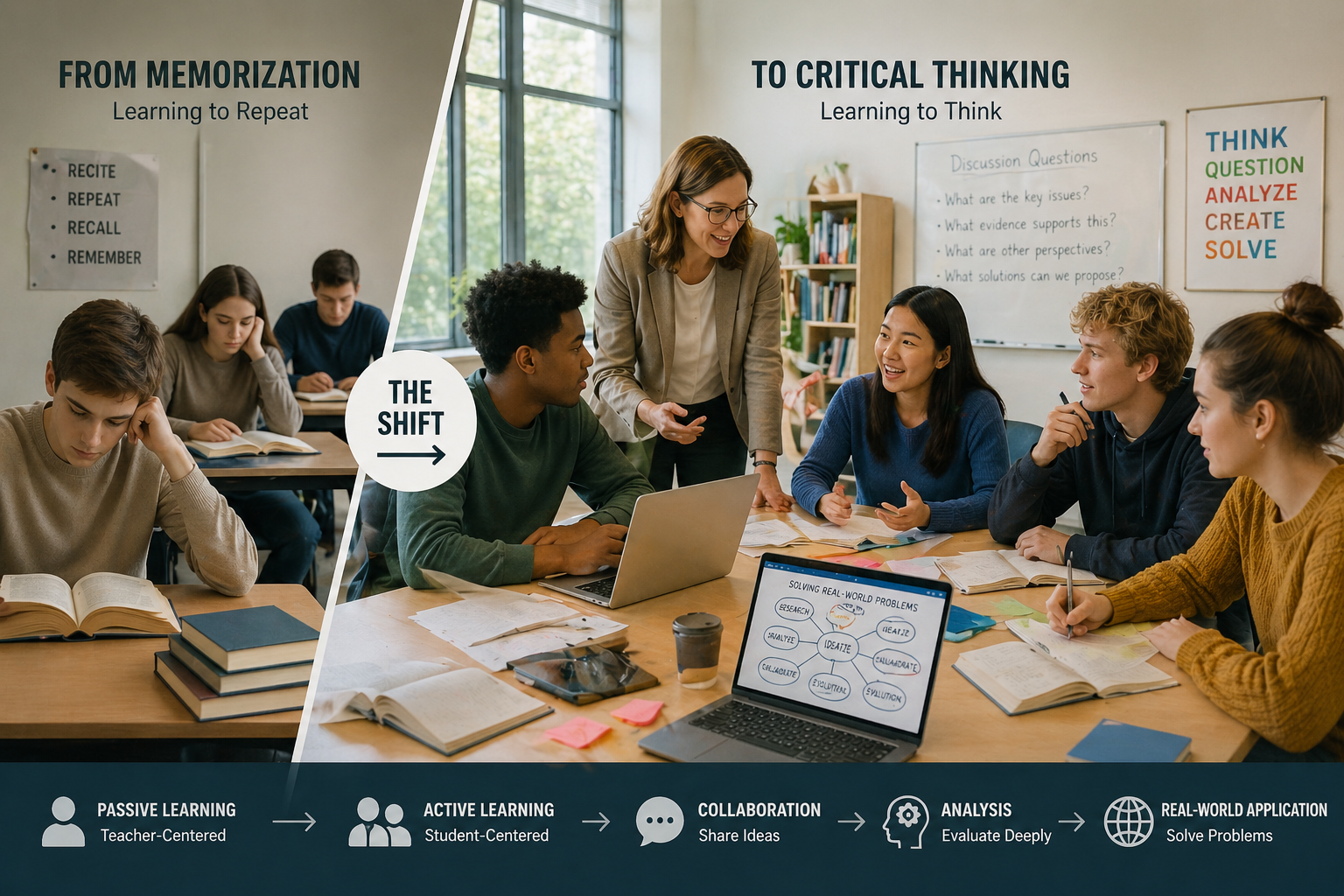
Memorization-Based Learning Concept
Memorization-based learning is a technique where learners commit to memory certain bits of information through constant repetition. This has always been one of the main pillars of education in various societies throughout history.
For instance, in the Western education system, memorization was an important aspect in the era of industrialization because schools had to ensure that learners had the skills and abilities that would enable them to perform repetitive tasks in factories without making mistakes.
Some of the pros associated with memorization include its ability to make sure that students develop a basic body of knowledge about various concepts like mathematics, vocabulary, and history. For any in-depth study of various disciplines, basic knowledge is key.
On the other hand, some of the cons of memorization-based learning include the following:
- It encourages passive learning
- Learners find it difficult to apply memorized knowledge in practice
- It fails to cultivate critical thinking skills
- Knowledge gained is temporary
Introduction of Critical Thinking in Educational Settings
Critical thinking means analyzing, evaluating, and interpreting information with logical reasoning. Rather than just accepting the presented data, one learns how to question and connect ideas, and to solve issues accordingly.
There have been some pivotal drivers for incorporating critical thinking in educational institutions in the West. An obvious driver is the need for an adaptive workforce that could work without close supervision.
Additionally, a lot of scientific and educational studies and theories, such as the theory of constructivism, encourage educators to create learner-friendly educational environments, where students become active participants in their learning process.
Skills related to critical thinking are:
- Analytical being able to analyze the information presented;
- Evaluation comparing multiple ideas and perspectives;
- Logical reasoning, drawing logical conclusions from collected information;
- Problem-solving real-life problems using acquired skills.
Key Differences Between Memorization and Critical Thinking
The move from memorization to critical thinking goes beyond differences in approaches to instruction. This is because it marks a paradigm shift in the process of educating the youth.
While memorization focuses on a passive approach to learning, critical thinking involves an active mode that involves the learner’s involvement with the subject matter through discussion and inquiry.
Classrooms have evolved from teacher-focused learning spaces to student-oriented rooms that emphasize collaborative learning and discovery processes.
Methods of evaluation have also changed, with many institutions opting for:
- Project-based evaluations
- Open-ended questions
- Student presentations and group work
- Analysis of case studies
Students benefit in distinct ways under these two paradigms, with memorization favoring short-term recall and critical thinking encouraging long-term comprehension and flexibility.
Critical Thinking in Western Classrooms
The Western educational system has incorporated several techniques that help foster critical thinking in class environments. The methods help to shift the student’s focus from memorization to engaging with content.
Firstly, problem-based learning is often adopted where students are exposed to challenges and are required to come up with appropriate solutions. The approach helps the students gain deeper insight while building their practical abilities.
Secondly, most institutions adopt the use of the Socratic Method, where the teacher poses a question, and the student is made to think and answer based on the question posed. Students are involved in group discussion and debate sessions as well.
Thirdly, modern curriculums have shifted focus towards interdisciplinary studies, whereby subjects are related so that a more holistic understanding is acquired. Application of knowledge in real-life situations is often considered when designing the curriculum.
Fourthly, the incorporation of technology is yet another factor that has helped to foster critical thinking. With digital media, students can get access to more information and collaborate remotely.
Examples of the Transition in Practice
This transition from memorization to critical thinking has been seen in practice within various educational institutions.
For instance, at some universities around the world, traditional tests have been replaced by research, which means that students need to conduct a study and defend their results.
At schools in Finland, which is often recognized as one of the most modernized education systems worldwide, learners apply the approach to phenomenon-based learning. They deal with issues in reality, combining various disciplines in the process of their solution.
Furthermore, in the US, many secondary schools implement project-based learning programs where students complete tasks like creating a sustainable city or making a business plan. Such an approach promotes critical thinking.
To sum up, all those examples show that the trend is currently practiced around the world.
Obstacles in Transitioning to Critical Thinking
Although the process has its advantages, some problems must be solved before any real progress can be achieved. One problem is the difficulty of adaptation for the teachers who are used to working with the former system.
A second problem concerns evaluation. Evaluation of students’ critical thinking is much more complicated than measuring their ability to memorize. For example, standardized tests are relatively easy to administer and grade, so they are difficult to replace with other forms of assessment.
Lastly, there is a problem of maintaining balance. Both skills, memorization and critical thinking, have their merits, and both are essential. If there were no memorization of fundamentals, it would be impossible to think critically.
Some steps should be taken to overcome these obstacles:
- Teachers’ training
- Evaluation reform
- Balanced use of both approaches
Importance of This Transition on a Global Scale
The change from memorization to critical thinking within Western education has global significance. Given the global impact that Western education systems have, it is only natural that other nations would follow suit.
In an era characterized by dynamic change and technology, critical thinking has become more relevant than ever before. Today’s employers need employees who can analyze a situation and solve problems in creative ways.
It also helps foster innovation and economic development within societies that promote critical thinking skills.
The Future of Education
In the future, the education system is expected to continue focusing on critical thinking and balancing it with fundamental knowledge. With the development of technology, the educational process will become even more interactive and customized for individuals.
Moreover, there will be an emphasis placed on such competencies as creativity, teamwork, and emotional intelligence. Lifelong learning will become a significant aspect of education, transcending its traditional confines within formal schooling.
Hybrid forms of education will prove to be crucial, combining traditional approaches with modern techniques. They will allow for the acquisition of both memorized information and critical thinking skills.
Conclusion: Striking the Right Balance
From memorizing information to being able to think critically is an important step in learning that has been taken by Western education systems. Though memorization lays down the base for all learning, it is critical thinking which is required in today’s world.
An education system that combines both memorization and critical thinking skills proves to be the most successful. Only then can educators prepare their students for the complexities of today’s era.
And now that we have witnessed this change in our education system, the importance of learning through memorization and critical thinking becomes obvious.
Contact Us
Contact us for a free consultation for student or visitor visas. Our immigration experts are ready to assist you.