The Future of University Admissions
University admissions have evolved into highly competitive and complicated processes in recent times. Millions of applicants submit their applications to different universities around the world. The current admission processes that involve manual reviews and assessments are not feasible anymore. Admissions personnel often find themselves overwhelmed by the large volumes of application materials and are required to assess applications and essays in limited time frames.
It is precisely at such a point that AI enters the scene and revolutionizes the admissions processes. It is imperative to understand the impact of AI on university admissions processes since universities leverage AI technology to transform their admission processes.
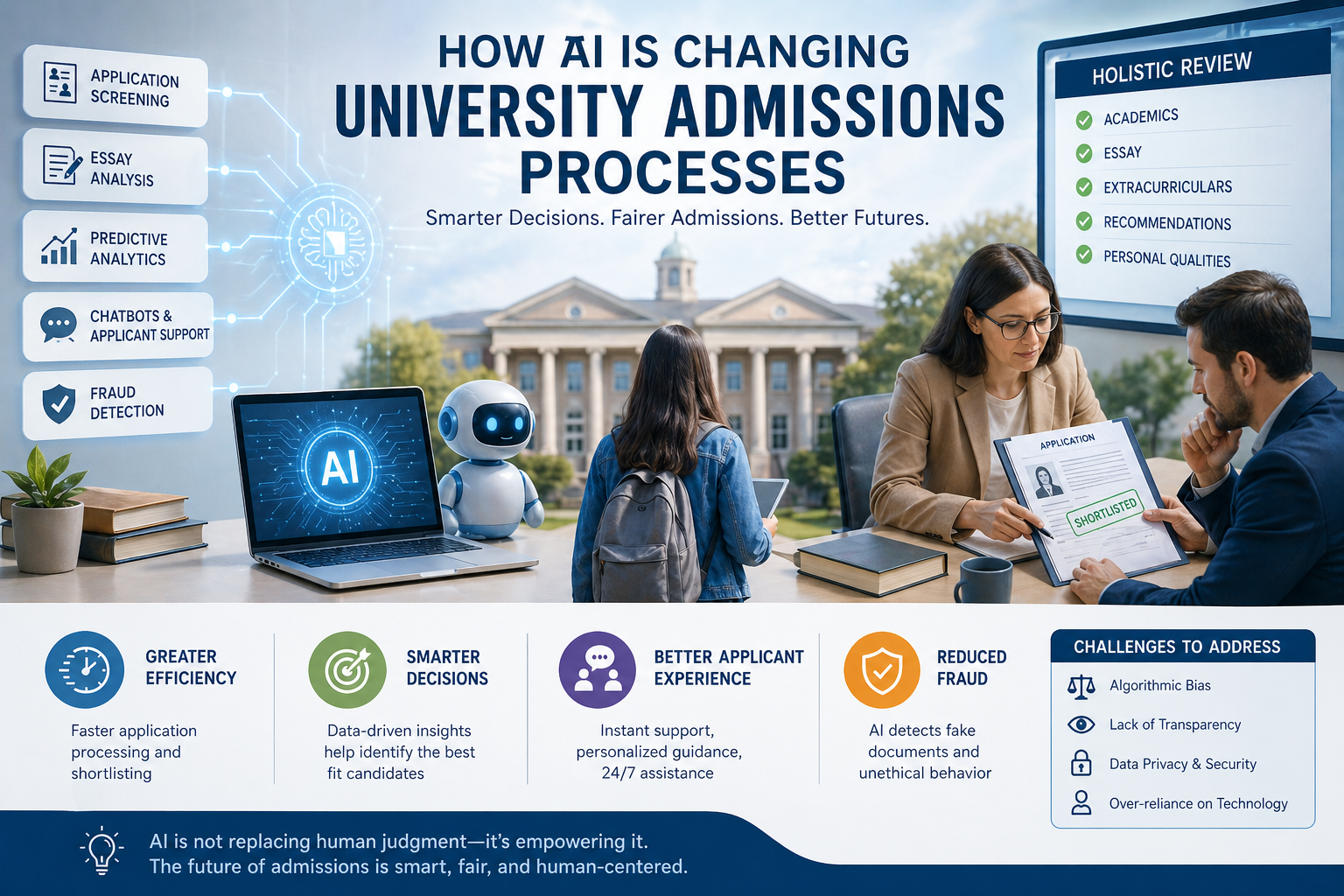
The Role of AI in University Admission Process
By definition, Artificial Intelligence comprises computer programs created to execute actions usually performed by humans through data processing and prediction. In terms of university admission, AI systems are introduced to help in assessing candidates, interaction with them, and ensuring the accuracy of their decisions made.
The usage of AI in the admission process is multifunctional and consists of screening of applications, analysis of student essays, checking for cheating, and prediction of successful candidates. The speed of data analysis is incomparable, since computers can analyze it in several seconds, unlike humans. Therefore, there is no threat of replacement of admissions officers with AI systems; on the contrary, they become assistants to human beings.
Top Three Methods by Which AI is Revolutionizing University Admission Processes
First and foremost, one of the most significant impacts of artificial intelligence on university admission processes is the automation of various evaluation stages. For instance, AI technologies enable automatic filtering of applicants through set criteria like previous academic results, meeting eligibility standards, and alignment with the university’s needs. Such automation makes it possible for universities to save a considerable amount of time on administrative procedures while focusing more on assessing applicants’ skills and abilities.
The second way AI is transforming university admission processes is through predictive analytics. Artificial intelligence evaluates historical information to identify specific patterns indicating that an applicant will do well at the university and complete their education successfully. Such an evidence-based approach ensures that universities admit students who will contribute to their academic excellence and meet other institutional objectives.
Finally, another innovative technology is AI-powered chatbots. They answer questions about deadlines, application requirements, scholarships, and other details regarding the application process. Furthermore, chatbots operate round-the-clock and help foreign applicants communicate despite the time difference between countries.
Moreover, artificial intelligence helps to make the admission process more personalized. The university could send individualized communication and suggestions based on each candidate’s profile. For example, a university could recommend particular programs for an applicant or remind a student about the deadlines.
Furthermore, essay evaluation is another task that AI algorithms help to perform more efficiently. AI-based tools could analyze grammar and structure. At the same time, only a human could check the creativity and originality of each piece.
Finally, the use of artificial intelligence helps in detecting any fraudulent activity. AI-based algorithms could check whether the documents submitted by an applicant were fabricated or not.
Advantages of Using AI in the University Admission Process
The increasing use of AI technology illustrates the extent to which AI is revolutionizing the university admission process through improved efficiency and reliability. The most notable benefit of using AI is that it enables much faster processing of applications, since it does not take as long for AI to process applications compared to humans.
Secondly, AI makes the work of admissions officers easier because it takes care of routine duties such as scheduling interviews and sending reminders to applicants, thus giving the officers more time to focus on other important issues in their job.
Additionally, the use of AI in the university admission process improves the applicant experience through the provision of automated services such as chatbots that enable real-time interactions between admissions officers and applicants.
Challenges and Ethical Issues
While the benefits of using AI in university admission procedures cannot be overstated, it is necessary to understand what challenges and ethical issues this process poses. Algorithmic bias is one of the most serious problems that universities face when introducing AI into their admission processes. AI algorithms use historical data, which may have certain biases that impact admission procedures.
Lack of transparency is another problem faced by universities implementing AI. These algorithms work as black boxes; therefore, it becomes challenging for universities to explain why a particular applicant was admitted or not. Moreover, privacy and security of applicants’ data are vital when discussing university admission procedures.
This data should be stored safely and confidentially. Lastly, universities may start depending on technology more than humans, thus reducing the significance of holistic evaluation.
AI in University Admission Processes: Real-World Examples
To gain insight into how artificial intelligence is affecting the admission process in universities, we should look at existing real-world examples where universities are applying AI to make their processes efficient without compromising on human supervision.
For example, UNC-Chapel Hill has been using an AI algorithm called Project Essay Grade to analyze the grammar, syntax, and writing style of essays submitted by prospective students. The system functions like a preliminary review that precedes human assessment.
Another university adopting an interesting blend of human and computerized approaches for evaluating application essays is Virginia Tech. In this case, a human and an AI algorithm work together to assess the essays, and when there is a large discrepancy between the two scores, a third reviewer comes in to resolve any discrepancies.
Clearly, these instances indicate that universities have embraced a hybrid approach whereby AI boosts efficiency, while human judgment plays an essential role in fostering fairness and holistic consideration.
Implications for Students and Applicants
AI technology continues to shape the behavior and decision-making processes of students when seeking admission to universities. With the increasing involvement of AI in the admission process, students are forced to change their approaches, which are now expected to be more efficient and faster.
As such, applicants should consider the need to present authentic applications. Although AI algorithms are efficient in evaluating application language and structure, they lack human sensitivity. Therefore, applicants should remain focused on presenting truthful stories.
Conversely, students are benefiting greatly from AI due to the availability of information. However, they should ensure that they do not exploit the technology to cheat.
AI in Admissions at Universities: The Future
Moving forward, it is anticipated that the application of AI in admissions will only increase. More and more universities will adopt new technologies that will make use of such techniques such as predictive analytics and AI-based interviews.
Some of the future trends might also involve better algorithms in collecting data and decision-making, more transparency in decision-making by AI, and enhanced ethical considerations when implementing AI into admissions practices.
Students’ Tips for Applying in an Era of AI
With AI shaping college admissions in new ways, there are several things students can do to give themselves an advantage. In order to do so, it is recommended that they:
- Prioritize genuine content over the use of AI technologies
- Make sure they have well-written applications without mistakes
- Feature unique accomplishments and skills
- Keep themselves updated on how universities use AI
These tips will ensure students gain an edge in an increasingly competitive environment.
Conclusion: Striking the Balance Between Innovation and Equity
In summary, it is crucial to understand the impact that AI is having on university admissions within the current digital environment. AI is revolutionizing admissions through speed and efficiency and is beneficial for both the university and the applicant.
But as mentioned above, there are also risks associated with this revolution, such as potential biases, opacity, and privacy concerns. And here comes the question of finding the right balance between innovation and human wisdom.
The future belongs to those who adapt to its changes. And for university students, that means being aware of the role that AI plays in their admissions process.
Contact Us
Contact us for a free consultation for student or visitor visas. Our immigration experts are ready to assist you.