When preparing for an exam, one has to do more than go through lecture notes and memorize all necessary information. Moreover, the method used for revision should also be adjusted to the exam format. For instance, when taking a closed-book exam, one is required to remember the information without having access to the notes, while in open-book exams, it is possible to consult some approved sources during the exam itself. Despite the fact that open-book exams seem to be easier, they require strong analytical skills and the ability to apply knowledge under time constraints.
Understanding the differences between studying for open-book vs. closed-book exams will help you select the proper methods of revision and use your time productively.
Understand the Difference Between Open-Book and Closed-Book Exams
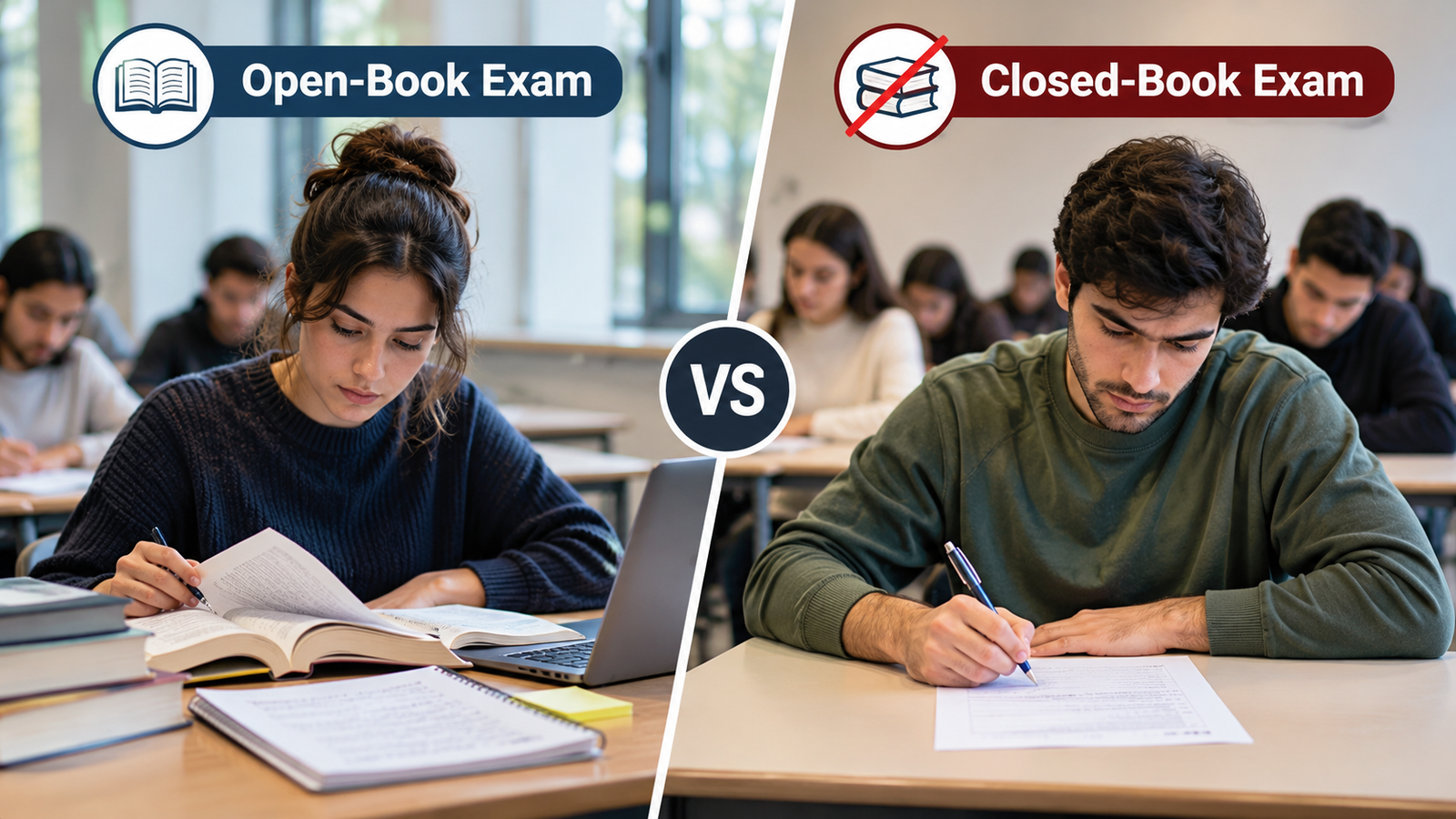
The major difference between open- and closed-book exams is the possibility of referring to your study materials while answering questions. However, this difference influences the skills that should be developed during preparation for tests.
Closed-book tests are those in which you will be expected to answer questions based on the information stored in your memory. In such tests, your ability to recall definitions, theories, formulas, and other facts is tested. In order to pass such tests, regular revision and self-testing are necessary since you cannot refer to the sources of the forgotten information.
An open-book test refers to those in which you are allowed to refer to certain materials, such as books, notes, or reference sheets. However, the availability of such materials does not mean that you will be able to use them to answer all the questions.
In both types of tests, you need to prepare, know the subject matter, and manage your time.
How to Prepare for Closed-Book Exams
When preparing for closed-book exams, efforts should be aimed at improving memory skills, mastering the ability to recall information, and understanding the material thoroughly.
Apply Active Recall to Improve Memory Skills
Active recall means trying to retrieve information from memory rather than rereading your notes time and again. After studying a subject, close your book and try to articulate the core of the information without looking into the text.
You can also create flashcards, answer sample questions, or write down all that you know about a particular topic. Review your work to identify areas where your knowledge needs further development.
Practice Spaced Repetition
Instead of working with one topic for hours continuously, break up your revision process into several days. Repeat the topic after the first study session and do it again later, and again prior to the exam.
Spaced repetition provides a person with a chance to improve their memory skills and learn what they forgot during previous revisions. This strategy is especially helpful when preparing for exams that consist of numerous chapters, terms, formulas, etc.
Practicing Writing Answers Without Notes
It is sometimes easy to recognize a right answer, but not necessarily possible to generate one without outside help. Practice responding to brief questions, solving problems, and outlining essay answers without referring to your notes.
For instance, if you study economics, try to explain the mechanics behind some economic theory and its assumptions without looking into your textbook. In this way, you will prepare yourself for more difficult questions that would require more complete explanation, not only recognition.
Focus on Understanding Concepts, Not on Learning All Material by Heart
Memorization is good for facts, terms, and formulas, while understanding allows you to see relations between concepts, apply them, and generate answers to various questions.
In this way, you will be able to remember information and use it effectively, regardless of the wording of the exam question.
How to Prepare for Open-Book Exams
Preparing for open-book exams requires putting more emphasis on understanding, organizing resources, and applying knowledge. The idea is to know the material well enough to work with your resources efficiently rather than search through them for answers.
Organizing Your Notes for Easy Reference
Organize your notes using headings, labels for topics, and page numbers. Create an index or summary that will help you access information faster during your examination.
You can highlight important definitions, formulas, theories, and examples if allowed by your instructor. You do not need to collect too many notes, making it hard for you to access the needed information. It is better to have fewer resources but organized.
Focusing on Application
Many times, open-book exams require students to analyze information, solve problems, interpret evidence, or apply the concept. Copying definitions from your textbook may not be enough to answer such questions successfully.
When revising for the exam, practice explaining how a certain theory can be applied in a particular situation or how a formula can be used to solve a problem.
Identification of Useful Material in Advance
Study the syllabus and past test questions, if any, to know about some of the important themes and concepts. Make sure that you comprehend those areas prior to the exam.
Create reference material for the information which you find hard to memorize but will need to refer to, for instance, statistical data, lengthy formulae, or specific parts. Do not rely on your notes when explaining something you have not studied.
Examination under Examination Conditions
Practice sample problems using all materials allowed during the examination. Give yourself an appropriate time frame and practice finding the necessary information without wasting much time looking for it.
That will help you ascertain how efficiently you have arranged your notes and whether you can use your knowledge in the allotted period of time.
Effective Study Strategies for Both Exam Formats
Though open-book and closed-book exams demand different approaches, there are still some study methods useful in both cases. Set a practical schedule. Break the syllabus into smaller pieces and plan how long you will study them. It is beneficial to begin early so you will have more chances to deal with complicated issues.
Apply practice questions. By solving them, you will not only understand your knowledge but will also get acquainted with the way information will be presented. Examine your errors to understand what led you to make the wrong choice. Describe the concepts in your words. The fact that you manage to explain something without using your notes shows your comprehension. Moreover, it helps to identify what should be studied once again.
Analyze your mistakes. Keep a record of them and return to the corresponding concepts in order to clarify your misunderstanding before the exam. Practice time management. Finish all questions in the specified period of time to learn how to combine speed and precision.
Common Study Mistakes to Avoid
The main mistake students often make is believing that when having an open-book examination, it would mean that little effort is needed for preparation. Being able to see the notes does not guarantee finding the right information quickly or being able to use them properly. Without enough understanding, any textbook prepared properly may fail to give you the right answer.
Another big mistake made when studying is placing too much focus on memorizing all the information during closed-book examinations. You might have learned all the definitions, but you will still struggle when there is a question asking for explanation or application of the concepts learned.
Common mistakes include making too many notes, neglecting practice questions, failing to follow examination instructions, or preparing at the last moment of the day. Some students even spend their time studying what they know while trying to ignore hard subjects.
Manage Your Time During the Exam
Time management will help you showcase your understanding of things without omitting anything. In the case of a closed-book examination, you should read the questions and know what the questions require you to answer. Then recall all the related concepts, briefly plan your answer, and give yourself enough time to respond based on the marks assigned. When you don’t have any idea about answering the question, leave the question temporarily and come back to it after answering other questions.
In the case of open-book examinations, avoid the habit of going through everything before writing answers. You can easily identify the required pieces of information, refer to that particular part, and use it to provide an answer. All this will depend on your prior preparation.
Time management, direct answers, and time for reviewing are key points in both cases. Obeying all the instructions is also very essential.
Conclusion
Open-book and closed-book exams need different strategies in order to prepare for an exam; however, both formats favor consistency and understanding of the topic. The benefits of closed-book exams include using active recall, spaced repetition, and practicing answering questions from memory. Open-book exams include organizing resources, analytical skills, and application of knowledge to answer the questions.
The best way to be successful on the exam is to figure out its requirements prior to selecting a revision strategy. Practice questions should help reveal weaknesses, organize your learning material accordingly, and provide skills to explain things. Eventually, the best way to prepare is not just to memorize facts and look them up while taking the test, but to comprehend and apply the gained knowledge. When preparing for an exam, one has to do more than go through lecture notes and memorize all necessary information.
Moreover, the method used for revision should also be adjusted to the exam format. For instance, when taking a closed-book exam, one is required to remember the information without having access to the notes, while in open-book exams, it is possible to consult some approved sources during the exam itself. Despite the fact that open-book exams seem to be easier, they require strong analytical skills and the ability to apply knowledge under time constraints.
Understanding the differences between studying for open-book vs. closed-book exams will help you select the proper methods of revision and use your time productively.
Contact Us
Contact us for a free consultation for student or visitor visas. Our immigration experts are ready to assist you.