Introduction
Starting a new chapter of your life in a foreign country is an amazing experience. However, when you arrive there jet-lagged, you are likely to feel exhausted, awake at night, and sleepy in the daytime. All of these factors are especially undesirable when your first class is waiting for you soon after your arrival.
The phenomenon of jet lag occurs due to the disruption of the natural rhythm of your body, which is regulated by your biological clock. This problem is only aggravated by crossing many time zones. However, there are ways to mitigate its consequences and be full of energy at the beginning of your studies.
Here we will discuss efficient and scientifically-proven approaches to dealing with jet lag before classes.
Jet Lag and the Factors Causing It
Jet lag is not only about exhaustion caused by prolonged flights, but also the physiological reaction to crossing time zones that causes a conflict between your biological clock and the new sleeping schedule. In essence, your body will be on time according to your native country, while your surroundings require something else entirely.
These effects include fatigue, insomnia, and frequent wakefulness during the nighttime, headaches, poor concentration, and even digestion disorders. It could be difficult for a student to follow lectures and contribute to discussions.
To cope with jet lag, the main thing is to get used to the new time as soon as possible. This process starts even before your journey begins.
Prepare Before You Travel
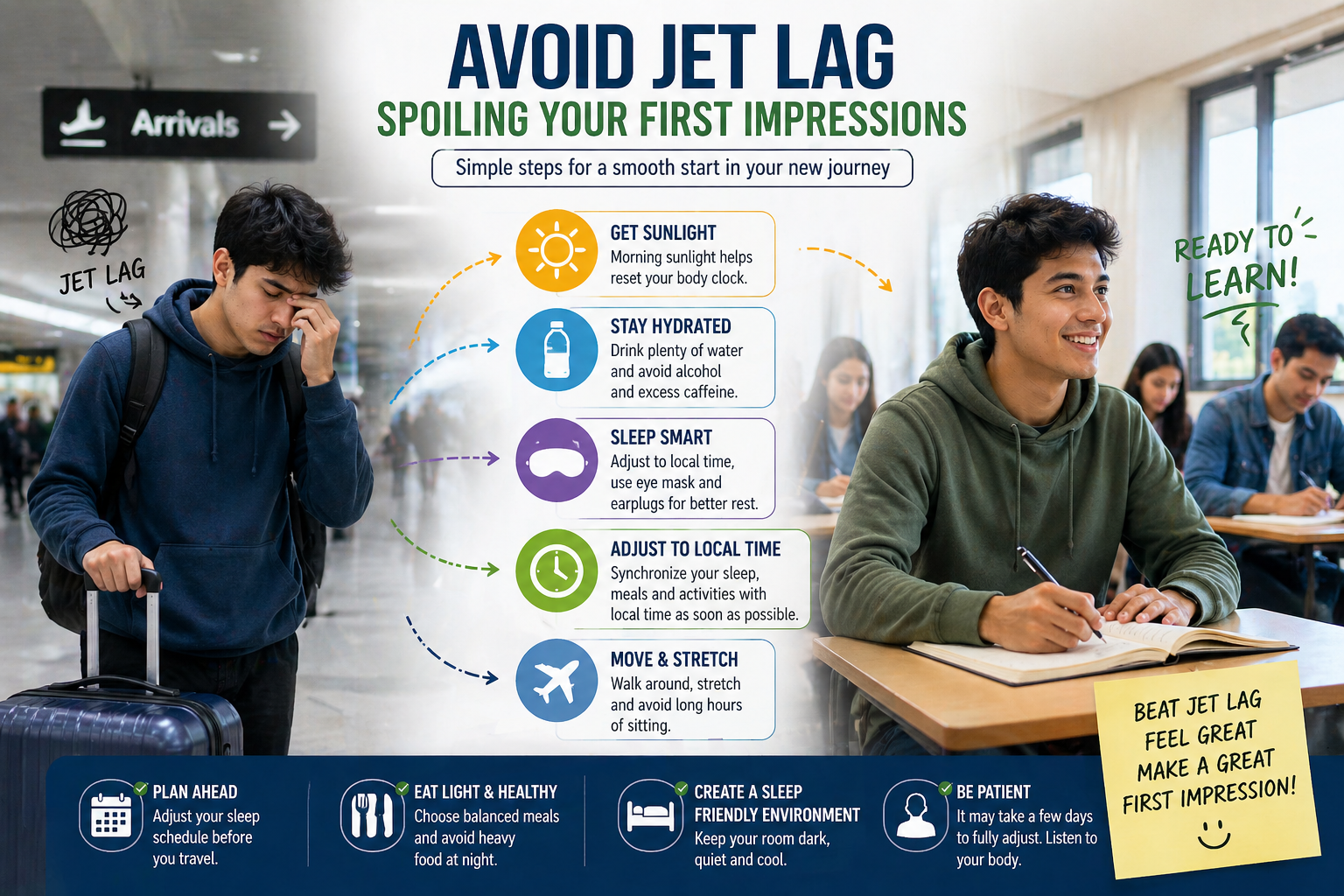
Perhaps the most common mistake made by students is not planning and dealing with the consequences of jet lag once they arrive. However, preparations should start a few days prior to traveling. To begin with, it is essential to adjust your sleeping schedule. If you are traveling ahead of your time zone, go to bed and wake up earlier each day. On the contrary, if you travel west, try waking up later. Even a small change of one hour per day may bring you great benefits.
Another factor to consider is the correct timing of flights. If there is an option, try choosing a flight that lands around 6 pm local time so you can stay up and go to bed at a proper local sleeping time. Landing during the morning hours may prove difficult due to a constant urge to take long naps.
The third key to success is staying hydrated. Plane cabins create a rather dry environment, which causes even greater jet lag problems. Increase your water consumption beforehand and avoid drinking alcohol or coffee.
Tips While You Are On Your Plane
What you do while you travel affects the recovery process significantly. One way to ensure fast recovery is to schedule your sleep according to the time zone of your destination. When your destination is at night, you may sleep while on board; otherwise, you should stay awake.
You can create a comfortable environment to get some sleep. For example, you may use a neck pillow, an eye mask, and earplugs. Besides, do not watch movies or check your mobile device because the light may distract you.
Moving around also helps you feel better. Otherwise, you may become lethargic, which means that fatigue will affect you. To avoid it, you should stand up, stretch, and walk through the aircraft now and then.
Another effective method involves adjusting the amount of light. It signals your body about whether it needs to rest or be active. Therefore, if you need to stay awake, leave your shades open and turn on the lights. On the other hand, blocking all light sources may help you fall asleep.
First 48 Hours After Your Arrival Are Most Important
It is very crucial for you to set the rhythm of your internal clock again. The main rule is to synchronize with the time in your destination right away. Even if you feel sleepy, it is better to stay awake until the regular time for going to bed.
If you want to have a rest, it will be okay to do this for 20-30 minutes only. Longer naps can worsen your condition because of increasing fatigue due to disorientation. If you experience great exhaustion, take a nap and resume your usual activities.
The fast way to readjust is getting sunlight. Go outside more and, in particular, in the morning, as sunlight will make your brain understand that it should be active at this moment. Even a walk will be enough to achieve this aim.
Eating meals in accordance with the local timetable is also helpful for setting up your rhythm again. You should not eat heavy food late in the evening since it might worsen your condition even more.
Sleep Hacks to Recover Faster
It is crucial to create a suitable sleeping environment to fight off jet lag. The room must be dark, soundproof, and cool. In case the hotel lacks blackout curtains, one may use an eye mask. Moreover, eliminating any noise can help facilitate better rest using earplugs or playing some white noise.
Another sleep hack is to restrict the use of electronic gadgets before sleeping. It has been found that phones and laptops emit blue light, which can negatively affect the melatonin levels required to sleep. One should try not to watch their phone at least half an hour before sleeping.
Lastly, some students prefer using melatonin supplements to regulate their sleep cycle. Melatonin is a natural hormone produced by the body to signal when it is time to sleep. Although the supplement might be effective, it is always advisable to seek medical advice before consumption.
Activities You Should Perform the Day Before Starting Your Classes
The day before starting classes is an opportunity for full recovery and preparation. It is not recommended that you remain in one place and rest. Go outside and perform some mild physical activities. For instance, you can take a walk around your neighborhood or college campus. In doing so, you will make your body accustomed to changes while avoiding exhaustion.
Try to organize yourself in advance. Plan what classes you will have, prepare all necessary items, and decide how to reach campus. Having a clear understanding of everything you will do will make the entire process less stressful for you and let you concentrate on studying.
Finally, try to go to sleep at regular intervals. Even if you do not feel tired at all, try to spend a couple of hours lying in silence in your room. It is essential to maintain consistency.
Things Not to Do
Students commonly worsen their condition by adopting unhealthy routines. Daytime sleeping sessions are one such behavior that hinders your adaptation to the new environment. Overconsumption of caffeine can also help you stay awake, but it hampers your ability to fall asleep at night.
Remaining confined to your room without stepping outside can harm your biological clock. It cannot function effectively without adequate sunlight. Dehydration is another issue that is often ignored; it contributes to exhaustion and physical pain.
Such behaviors should be avoided to improve recovery from jet lag.
How Long Will It Take for Jet Lag to Wear Off?
Jet lag does not wear off quickly; however, it will get better over time. On average, jet lag usually wears off after a day per time zone you crossed. However, jet lag can last differently based on your lifestyle, direction of travel, and whether or not you take appropriate measures.
Students who manage to change their sleeping schedules, remain hydrated, and receive sufficient sunlight tend to overcome jet lag more quickly compared to students who neglect these methods.
Conclusion: Begin Your Classes Refreshed and Alert
Jet lag is something that most international students encounter, but there is no need to let it hinder the beginning of your classes. All you need is some preparation prior to your journey and healthy practices on your way here, and once you get here, you will be able to cope with it successfully.
All you need is to stick to certain rules. Adjust yourself to the new time zone as fast as possible by arranging your sleep schedule, nutrition, and all other activities accordingly. Little things, such as going out into the sun, staying well-hydrated, and refraining from sleeping in, can help you achieve your goal.
Now you can attend your classes feeling energized and ready to learn new things.
Contact Us
Contact us for a free consultation for student or visitor visas. Our immigration experts are ready to assist you.