Introduction
The popularity of higher education in Lithuania among international students has risen due to the availability of affordable education and recognized diplomas. With universities such as Vilnius University and Kaunas University of Technology, Lithuania provides students with excellent conditions for learning, with relatively cheaper tuition compared to Western European states.
In order to get admission into these colleges or universities in Lithuania, students first have to apply for their student visas. These include getting the Lithuanian National Visa D and Temporary Residence Permit. This guide explains all aspects of applying for a Lithuanian student visa.
Why Go to Lithuania?
Lithuania is considered to be one of the most affordable places in Europe for studying abroad. The prices for tuition are quite low, while the cost of living in Lithuania is considerably cheaper than in, for instance, Germany or France. Many subjects are taught in English, including but not limited to IT, business, engineering, and medicine.
Besides, Lithuania is a very safe place where an active student community will support you. There are many cultural sites, modern architecture, and a comfortable student life in the cities of Vilnius and Kaunas. Besides, you will have an opportunity to work part-time while studying.
Understanding the Lithuanian Immigration Policy for Students
Lithuania’s student immigration policy mainly consists of two documents.
National Visa (D): Short-term visa which usually expires after 12 months
Temporary Residence Permit (TRP): Necessary for prolonged study programs (more than one year)
Over the last few years, there has been an increasing tendency among the majority of international students to obtain the Temporary Residence Permit because it gives the right to stay in Lithuania during the whole period of studying. Usually, TRP expires in 1-2 years (or even longer for PhD students).
Criteria for Application to a Lithuanian Student Visa
A candidate seeking a Lithuanian student visa or TRP must fulfill some key criteria. The first criterion is obtaining an admission letter from an accredited Lithuanian university. If not, your application will be disqualified.
Another criterion involves having enough funds, estimated at €300 to €500 monthly or €3,600 to €5,000 yearly, to support oneself. You will also need health insurance covering up to €30,000. Other criteria may include a valid passport, proper housing evidence, and a good behavior or no criminal record certificate.
Checklist of Required Documentation
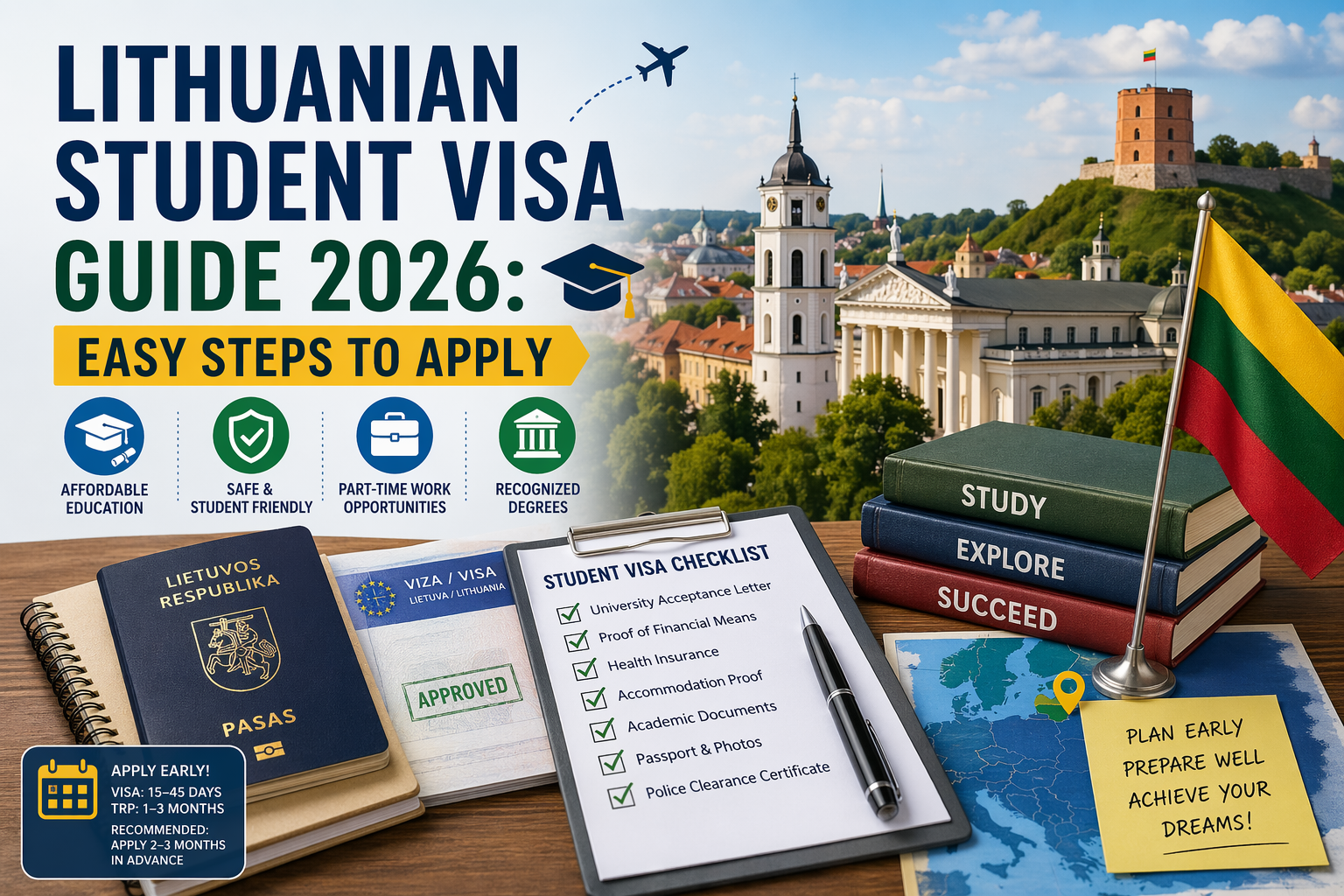
Proper documentation is among the key requirements when applying for a Lithuanian student visa. The following list represents what is generally required.
Completed visa/TRP application form
Current valid passport (valid for at least 10 years from issue date)
Passport photos
University acceptance letter
Evidence of payment for tuition fees (if any)
Statements of account/sponsorship
Document confirming accommodation arrangements (housing/dormitory)
Certificate of health insurance
Academic transcripts/certificates
Clearance/police verification certificate
Translation and legalization of most of these documents to English or the Lithuanian language is commonly overlooked but essential.
Step-by-Step Visa Application Procedure
The procedure for obtaining the Lithuanian student visa involves following specific steps carefully.
To start, you will have to gain acceptance into a Lithuanian educational establishment, and once you have done so, the institution will issue you a mediation letter, which will be submitted via an online migration system operated by the Lithuanian government.
Afterwards, you are expected to apply for the visa, or TRP, using the online migration system called MIGRIS or applying externally via VFS Global and filling in the application forms provided.
Once you have completed the application and paid the fee, you will then go through an appointment for biometrics and verification of the supporting documents, while in some cases, you will be required to attend an interview with specific questions regarding your education, finances, and motivations for studying in Lithuania.
Lastly, after submitting the application, it goes under review, and if successful, you will obtain the visa or TRP.
Visa Application Fees & Processing Time
It is important to know the process time and fee in order to plan your relocation. As for the cost, a D visa usually goes for €120, and the TRP fee varies between €80 and €120 based on the process type.
Process times are as follows.
Visa (D): Between 15-45 days
TRP: Between 1-3 months based on the process type selected
Given the above process times, it is advisable to apply at least 2-3 months in advance.
After Arriving in Lithuania
When you arrive in Lithuania, you still have some work left to do. If you traveled with a visa, you should get your Temporary Residence Permit either collected or completed. This means visiting the Migration Department and completing other tasks.
You will also need to register your address, open a bank account, and finalize your university admission process. It is important to make sure that everything is done correctly.
Part-Time Job while Studying in Lithuania
The main benefit of studying in Lithuania is the opportunity to find a job and earn money to pay bills. International students are allowed to work part-time at 20 hours a week in academic terms and full-time in breaks between terms.
If you study here, you may be interested to know that no separate work permit is necessary for foreign citizens as long as you have a residence permit.
Common Mistakes to Be Aware Of
Student visa applications can be denied or delayed because of avoidable mistakes. Providing incomplete or inaccurate documentation or failing to translate certificates are just some of the common mistakes that students tend to make when applying for visas.
Submitting an application at the last moment is another mistake that students tend to make. Because it can take several months to process the application, this will put you at risk of missing the deadlines for studying in Lithuania.
Tips on Succeeding With the Lithuanian Student Visa Application
In order to improve your chances of success in obtaining a student visa, begin the application early, providing all of the necessary documents. Make sure that you have clear information on your finances and can discuss your intentions to study in Lithuania.
Checking your application status online using the MIGRIS or VFS system is also recommended.
Conclusion
It may seem like acquiring a student visa in Lithuania is difficult, but once you know what to do and how to prepare, the process will become simple and easy for you. From getting accepted by the institution you desire to eventually receiving the Temporary Residence Permit, all these steps are essential when it comes to becoming a student in Lithuania.
Because of its low tuition rates, high reputation among the international community, and its student-friendly policies, studying in Lithuania is definitely a great choice. Follow the guidelines mentioned above and begin your adventure in the field of higher education!
Contact Us
Contact us for a free consultation for student or visitor visas. Our immigration experts are ready to assist you.