Electing Your Future Career Path After Graduation
The reason why many students choose to study abroad these days is not limited to education alone; it lies in their future career opportunities. And one of the most important considerations here would be the possibility of getting a post-study work visa.
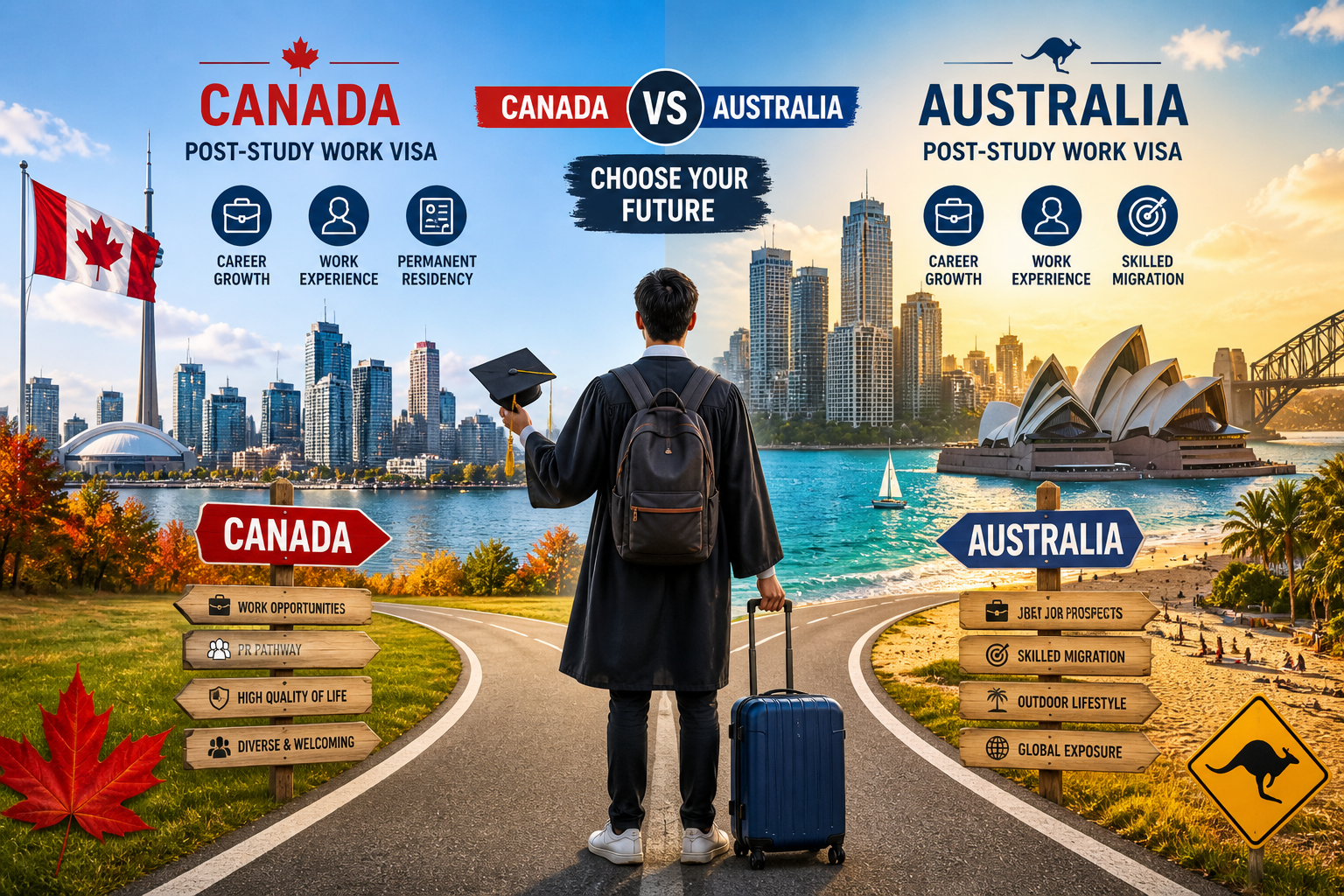
Australia and Canada have both established themselves as the top contenders when it comes to post-study work visas. However, with changes made to their visas recently in 2025 and 2026, respectively, the situation has been altered quite a bit.
But what does that really mean for you as a prospective international student? Here’s everything you need to know.
Post-Study Work Visa Defined And Why Does It Matter?
A post-study work visa refers to a permit allowing international students who have completed their studies to stay in the country of study and get work experience. This period is important in that it marks the link between your academic and professional career.
Importance of the visa:
- It assists you in moving from being a student to becoming a professional
- It provides you with international work experience
- It plays an important part in permanent residency
To sum it up, it all depends on how successful you become through your post-study work visa.
Post-Graduation Work Permit in Canada: An Overview
Canada offers a permit called the Post-Graduation Work Permit, also referred to as PGWP, which is considered one of the most versatile immigration programs that can be chosen by international students.
Firstly, note that the PGWP is an open permit, which allows you to freely choose any position within the territory of Canada without being tied to a particular employer.
The time of validity for the PGWP will vary depending on the program you attended. If you completed a course of less than two years, then the validity period will correspond to its duration. If you studied at a school for two or more years, then the work permit can be obtained for three years.
Some modifications have been observed in 2025 and 2026. Language tests are now mandatory for some students, and certain non-degree courses have limitations. However, the Canadian government has stabilized the eligibility list, which is beneficial for students looking towards their plans.
For instance, a student completing their two-year Master’s program in Canada will receive an open work permit for three years. This permit enables them to earn work experience and apply for permanent residency.
The Canadian system differs from other countries since it offers a systematic approach from education to work and finally to permanent residence.
Overview of the Australia Temporary Graduate Visa (Subclass 485)
Australia provides the Temporary Graduate Visa, which is also referred to as the Subclass 485. It enables overseas students to remain and work in Australia after their graduation.
There are various pathways under the visa based on the nature of your qualification. For instance, you can apply for the Post-Higher Education Work pathway or the Post-Vocational Education Work pathway. Every pathway comes with unique conditions and validity periods.
The government has made recent changes to the program. The changes have included reducing visa validity periods, enhancing English language proficiency requirements, lowering the maximum applicant age, and discontinuing temporary extensions.
For instance, an individual holding a Bachelor’s Degree from Sydney is eligible for post-study work visas. However, the number of years they can stay is shorter than before.
In spite of all the modifications, Australia still remains popular among international students because of its good job opportunities, particularly in the field of health care and engineering.
Key Differences between Canada and Australia to Remember
In terms of comparison of the two nations, several crucial aspects need consideration.
The first notable difference relates to visa flexibility. Canada provides an open work permit; that means you can work for any employer you like. In contrast, Australia will depend on the type of visa stream.
Duration of stay is another vital aspect. While Canada offers stays from three to four years, this period in Australia varies from person to person and is dependent upon your education level.
Furthermore, obtaining permanent residency becomes quite an easy process in Canada due to its efficient immigration system. On the other hand, Australia employs a points-based immigration system.
The last but not least difference includes the policy direction. Canadian visas have become more selective recently, but the process is still quite steady. On the contrary, Australia introduced additional requirements in recent policies.
Thus, while Canada offers more stability, flexibility, and security, Australia boasts a high-quality life and attractive conditions.
Paths to Permanent Residency
Permanent residency can be obtained through various pathways in Canada, which are highly associated with the work experience of graduates. Such paths include Express Entry, Canadian Experience Class, and Provincial Nominee Program, among others.
Permanent residency is possible in Australia through the Skilled Independent Visa and Skilled Nominated Visa, although the paths require a lot of occupation points and lists. Work experience and relevant career paths play crucial roles in gaining permanent residency in both countries. Still, the path in Canada is simpler compared to Australia.
Career Prospects and Job Market
Both countries provide good career prospects and job markets, although the prospects differ from one sector to another.
There are job openings in various sectors in Canada, including:
- Software development and information technology
- Health care
- Engineering
Australia also provides good opportunities in:
- Health care
- Construction
- Engineering and mining
Whereas Canada has low tuition fees but very expensive living standards in cities, Australia provides good salaries but with higher costs of living than in Canada.
For one to succeed in either of the two nations, local experience is very critical.
Lifestyle and Living Experiences
Lifestyle should be considered when selecting between the two countries.
There is a multicultural lifestyle in Canada, along with good government services and security for permanent settlement. The climatic conditions may not always be favorable, particularly during the winter.
The climate in Australia is warmer. It is known for the outdoor lifestyle and a less stringent approach towards working. This lifestyle lures most students.
This choice would depend on one’s likes and dislikes regarding the different living conditions.
Which Country Will Suit You Best?
It all depends on what you wish to achieve.
Choose Canada if you:
- Require permanent residency status
- Wish to be more flexible with job options
- Seek stability regarding immigration
Choose Australia if you:
- Enjoy warmer weather conditions and lifestyle
- Possess a great profile in a particular skilled profession
- Seek international exposure in the short to medium term
Common Errors That Should Be Avoided
There are some common errors made by students while deciding where they should study.
- Not paying attention to new policies related to the visa
- Choosing a course that is not eligible for a post-study work visa
- Deciding a country solely based on its universities’ ranking
- Lack of planning related to getting permanent residence
By avoiding these common errors, students have greater chances of succeeding after graduation.
Actionable Tips for Students for the Year 2026
Here are some actionable tips for students in 2026 to get more out of their post-study work visas:
- Opt for degree courses in preference to diploma courses for eligibility in Canada
- Refer to the list of occupation demands before picking a course in Australia
- Gaining work experience through internships while still studying
- Improving your test scores in English
- Applying for the visa as per the deadline set by the government
Conclusion: Taking The Right Decision After Studying
Comparison between Canada and Australia reveals distinct contrasts between them regarding flexibility, migration, and lifestyle.
Canada presents more promising prospects for the future due to the flexibility of work as well as immigration opportunities. Australia presents a great lifestyle along with job opportunities. However, changes have been made to their visa policies.
In essence, the ideal decision will depend on individual objectives and preferences. Those seeking long-term settlement and a career should prefer Canada. Those seeking international experience, along with a great lifestyle, can choose Australia.
In conclusion, studying abroad is not only about education. It is the first step towards one’s future career.
Contact Us
Contact us for a free consultation for student or visitor visas. Our immigration experts are ready to assist you.