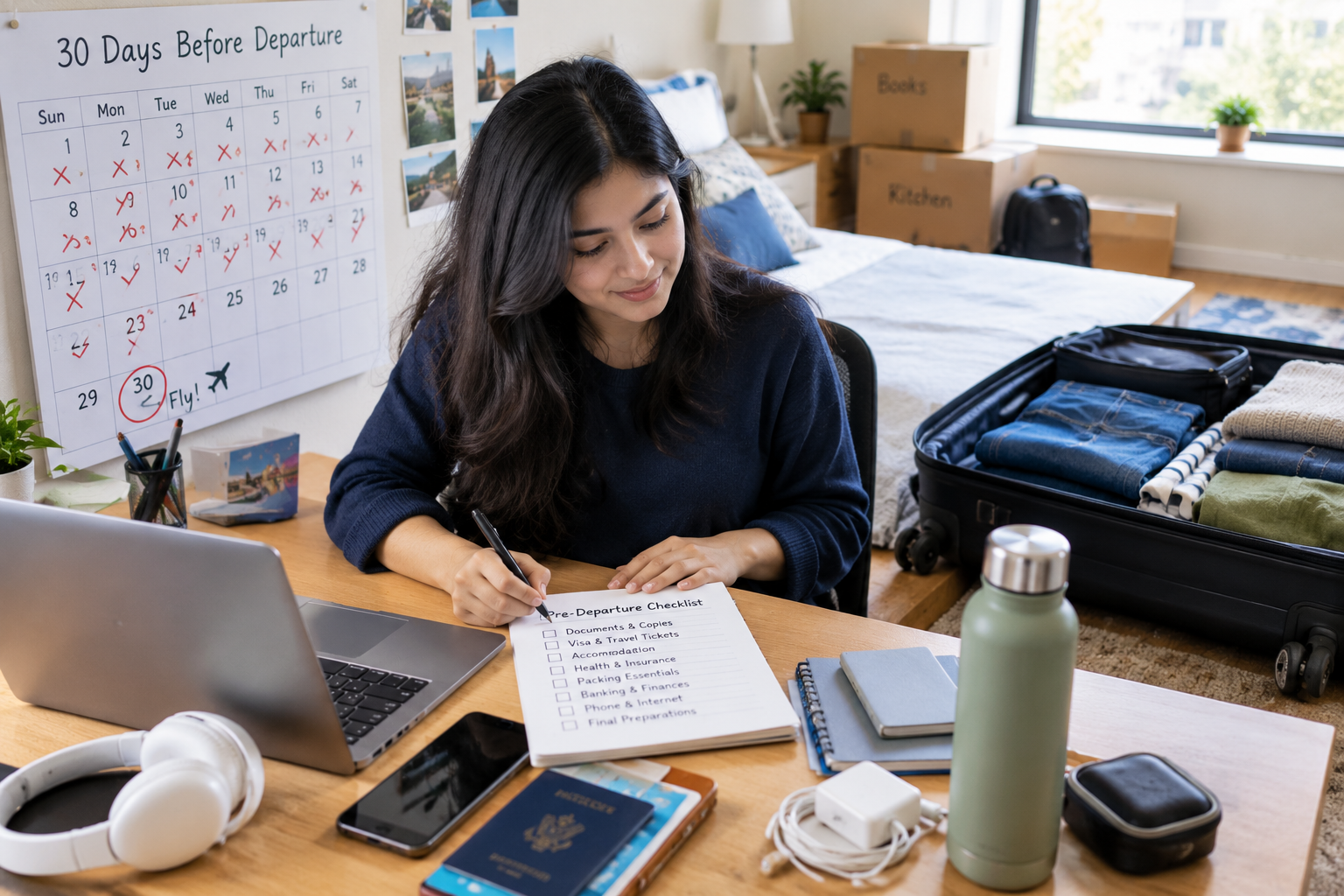
Your flight is set up, your visa is all sorted out, and your lengthy wait to study abroad is coming to an end. However, the 30 days remaining before your flight may be quite stressful if you forget to take care of some important things right away.
There are many more things to do for international students when it comes to getting ready to fly apart from gathering clothes. It is necessary to gather your travel documents, secure your accommodation, sort out your financial situation, look into the medical and pharmaceutical preparations needed, plan your airport pickup, and get prepared for your first days abroad.
A decent pre-flight checklist will help you complete these tasks step-by-step. You will have time to prepare properly instead of rushing around during your last week before flying.
1. Confirm Your Travel and University Details
After the initial confirmation of the most important travel details, move on to the next stage of your 30-day preparation period. It involves reviewing your university schedule. Make sure that your enrollment day, orientation program, first class day, and any arrival deadline dates are correct. Some universities will provide you with detailed information on what to do if you plan to arrive before the orientation starts.
You also need to make sure your accommodation is confirmed. Find out the full address, check-in day and time, and how you will get the keys to your room. Write down all the important information and save it on your phone, while keeping the hard copy ready just in case you do not have internet access right after landing.
2. Organize Your Essential Documents
Your travel documentation must be one of the most important priorities on your list of tasks to complete before going abroad as an international student.
Ensure your passport is valid and you have the proper visa/immigration documentation for the country you are planning to visit. Collect your enrollment documents from the university, accommodation details, flight arrangements, insurance documentation, and other relevant documents that may be required when entering the country.
Carry all important documents in your hand luggage rather than checked baggage. It is also wise to have digital backups of your important documents that can be accessed regardless of whether you lose your mobile or not. Keep your documents organized in such a way that you can easily find the necessary document at the check-in desk, the immigration desk, or while registering at the university.
3. Prepare Your Money and Banking
Financial preparation is yet another crucial step you should undertake prior to embarking on a study abroad experience. Have enough money at your disposal to deal with your first expenditures, which might include travel from the airport, food, costs associated with accommodation, phone service, and other basics.
Find out whether your credit or debit card works internationally. Consider foreign transaction fees, withdrawal fees, and other possible conditions from your bank. It is also logical to be able to pay in local currency in order to meet your immediate expenses after your arrival. You don’t have to carry too much cash with you, but having some of it will come in handy if you are not able to use your card right away. It is a good idea to keep your emergency cash apart from your daily allowance.
4. Check Health and Medication Needs
Do not wait until the last minute to prepare healthwise before your flight. If you require regular medical attention, think about having appointments before your departure. Get refills on your prescriptions and research your destination country’s regulations for traveling with them.
Some countries have restrictions on taking medicine and controlled drugs into their borders. Make sure to travel with your medication properly packed in the original packaging along with all necessary prescriptions or documentation.
Make sure that your checklist for international students includes your travel/health insurance details as well. Know what your insurance covers and keep all your policy information handy. Take any basic health items you might need for the first couple of days.
5. Plan Your Arrival at the Destination
Knowing how to get from the airport to your accommodation may help you with your first few hours abroad. Find out about transportation means that you may use prior to your trip depending on your destination: train, bus, taxi, ridesharing, or transportation that is arranged by the university.
Have your accommodation address saved offline because you might have to show it to the immigration authorities, driver, or transport provider. Check how you will check in at your accommodation. If you arrive outside the working hours, make sure you know how you will enter your accommodation.
Always have a backup plan for possible delays. Have the accommodation’s contact information accessible to contact them in case of a delay in your flight.
6. Start Packing Strategically
Packing must start well ahead of the date of departure. To begin with, determine the baggage allowance and restrictions of your airline. Weigh your bags before boarding in order not to be caught up in extra charges at the airport.
Pack considering the climatic conditions and living standards of your destination rather than packing all the stuff from home. You must pack necessary clothes, study materials, important stuff, etc., which cannot easily be obtained once there. Make sure that you do not overlook useful items like chargers, adapters, basic toiletries, and clothes suitable for the climate.
Your carry-on will include those items without which you will not be able to function if lost or stolen while travelling. These items include passport, immigration documentation, medication, money, electronics, etc.
7. Prepare Your Phone and Technology
Your phone is likely to be one of your most useful items after arrival in the new place, so make sure that it is prepared before you leave. Make sure that your phone is unlocked and compatible with the mobile network in the new place. Find out about the available SIM or eSIM plans and how to use them when you land.
Install some useful applications in advance. This includes the university app, transport applications, applications related to your bank accounts, maps, means of communication, and verification applications. Don’t forget to make backups of academic and personal information. Save copies of university information, identification information, and other necessary information. Don’t forget to bring the right charging accessories.
8. Complete Your Final University Tasks
Before you leave for good, make sure that you go through all the messages and documents you have received from the university.
There are some universities that need their international students to complete online registration, submit their documents, pay any remaining fees, complete their housing requirements, and send in their arrival information before commencing their classes.
Make sure that you check your student portal and your email carefully, and if there is anything that you have not completed, then make a list of them and try to complete those things before your departure. It would also be wise for you to read the university’s orientation information.
9. Create a First-Week Survival Plan
There is no need to plan your entire first week, but having a plan may be useful for easing into this experience. Figure out where you will be able to purchase your groceries, travel, visit the pharmacy, and obtain any other necessities from the places near your residence.
Locate where the university’s international students’ office or general student service offices are located since they can assist you with many things. Think about your first meal, travel, connection, and basic shopping requirements. Being prepared with these things means that you will be able to focus on adapting to your new surroundings instead. Your first week will be all about adapting. Do not expect everything to be already known to you at once.
10. Complete Your Final 48-Hour Check
On these last two days, do not start any big activities. Instead, this period should be reserved for a final inspection. Double-check your flight details and the airline requirements as well. Re-inspect your passport, visa, university papers, money, medication, phone, chargers, and other important items.
Weigh your luggage one last time. Fully charge your devices and have important details accessible even when offline. Let a trusted person know about your flight schedule and estimated time of arrival. Lastly, get some rest. An international flight becomes less difficult with enough rest.
Conclusion: Leave Prepared, Not Panicked
The last 30 days before going to study abroad will be better spent preparing than panicking. A comprehensive pre-departure checklist will provide an effective way to prepare yourself for all tasks before boarding your plane.
You have to start with the basics: secure your travel information, sort out your documentation, finance issues, health and medications, arrange for transportation to campus, and begin packing early. Then, sort out technological issues, university matters, and your first week plan.
It will be impossible to predict all kinds of situations that may arise while traveling abroad, but most of them can be avoided if you prepare well enough beforehand. The idea is simple: get all essential information, finances, stuff, and the first step sorted out, and you will be able to concentrate on the rest.
Contact Us
Contact us for a free consultation for student or visitor visas. Our immigration experts are ready to assist you.