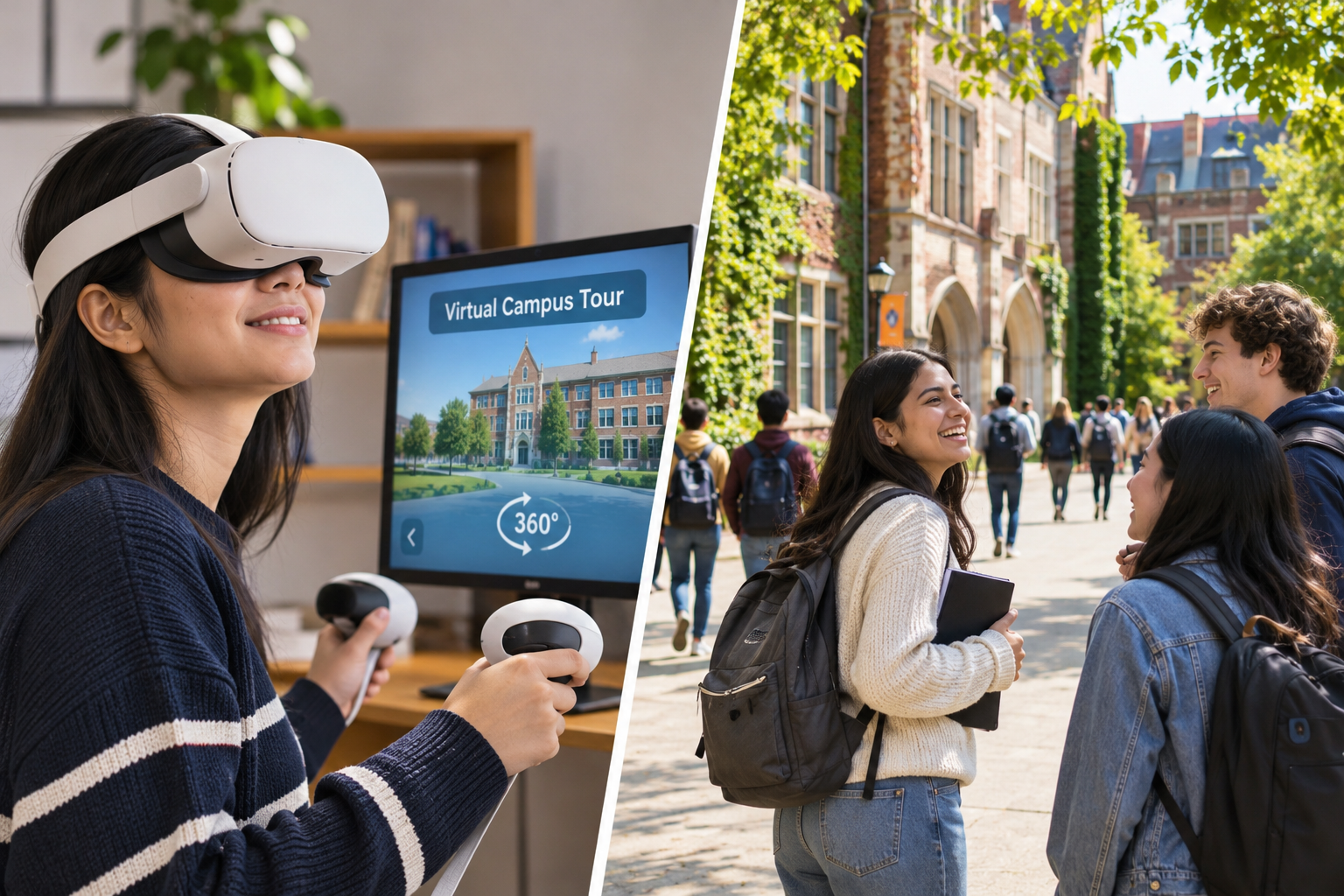
Choosing a university depends not only on curricula, tuition costs, and ratings but also on students’ understanding of where they will study, live, and make friends. Virtual reality campus tours let applicants get familiar with university facilities no matter where they are. They can use their computers, smartphones, or VR headsets to see lecture rooms, libraries, dormitories, and other university facilities without travelling.
For international students, such tours can be especially useful, as visiting universities in different countries can be expensive and time-consuming. However, virtual tours cannot recreate everything that happens at a university. Atmosphere, daily communication, neighbourhood, and personal experience of visiting these facilities can affect students’ choice.
Understanding the differences between virtual reality campus tours and in-person visits helps students make more informed decisions.
1. What Virtual Reality Campus Tours Can Show You
Virtual reality campus tours offer an easy way to visit university environments before submitting applications and even accepting offers. Using available technology, students can navigate 360-degree images, explore interactive spaces, and travel through different parts of campus.
Key features of virtual tours include lecture halls, libraries, laboratories, student centres, sports facilities, and accommodations. This way, students can learn the campus layout and choose facilities that support their studies. For instance, when choosing an engineering major, a student can look for laboratories and specialized classrooms. If the student plans to study abroad, they should focus more on accommodations, dining facilities and study areas.
Thus, virtual tours let students compare several universities without visiting. However, their effectiveness depends on the facilities shown, image quality, and the date of creation.
2. What You Miss When You Cannot Experience the Campus in Person
The Atmosphere of Everyday Student Life
A virtual tour can tell you a lot about a university building. However, a virtual tour can’t describe what the environment inside that building is like during classes.
It may be useful to visit in person to learn something about the everyday life of a campus. Pay attention to things like overcrowding in common facilities and the atmosphere during breaks between lectures. These observations matter because students will spend a lot of time on campus in the future. While pictures can show the best sides of a university, reality can be far from that.
The Reality of Campus Facilities
Pictures are often taken from the most flattering perspectives and angles. As a result, a library may seem spacious, and classrooms may seem modern and fully equipped. However, one should also consider seating comfort, maintenance issues, accessibility, etc.
An in-person visit lets you examine these features in more detail. You can also ask whether certain facilities are open to all students or specific to certain courses and activities. Virtual tours help with preliminary research, but students should confirm key details through current university sources and ask questions.
The Surrounding Neighbourhood
University life is not confined to the campus itself. Students need easy access to public transportation, food, groceries, medical services, and appropriate housing. A virtual tour of the campus can show the main entrance but won’t indicate how far the nearest bus stop is or whether essential services are close enough to reach on foot.
Additional research, such as studying maps and local transport schedules and looking for student accommodation on one’s own, can compensate for these shortcomings. An in-person visit will give even more detailed information.
3. Student Culture and Social Interaction Are Hard to Capture Virtually
A university is more than buildings. It is also a community built on students’ interests, social activities, cooperation, and interaction. While virtual reality tours of campuses may feature pictures of student lounges, societies, sports facilities, or event spaces, these images cannot show how students interact or whether certain activities are actually happening.
When visiting the campus in person, prospective students can see student groups, attend events at the university, and talk to people already studying there. This way, they may get useful information about the workload, social life, teaching support, and challenges of the university experience.
Students who cannot visit the campus should look into online open days, student forums, and conversations with current students.
4. Can a Virtual Tour Help You Judge Academic Quality?
Virtual tours may show students what resources the university offers. These can include specialist labs, research facilities, libraries, lecture theatres, and collaborative learning spaces.
Nevertheless, impressive facilities do not guarantee high-quality education or academic support. A good lab cannot tell students how often they will have access to it, what level of personal tutoring will be provided, or whether the facilities suit the chosen study program.
One should consider the course structure, information about the modules offered, the expertise of the academic staff, and assessment and academic support separately. Students can also attend virtual information meetings to ask academic staff questions directly about teaching.
The best way to learn more about the physical environment and academic quality is through virtual tours and course information.
5. Virtual Reality Campus Tours vs. In-Person Visits: Which Is Better?
Both methods provide valuable information but have unique advantages. Virtual reality campus tours are convenient, relatively inexpensive, and accessible to students everywhere. They are especially helpful when comparing several universities early in the research process.
Personal visits allow direct observations that digital means cannot provide. Students can evaluate the atmosphere, examine facilities, explore the neighbourhood, and talk with members of the university community.
Neither method gives a full picture on its own. A personal visit may be incomplete if it happens during holidays, when the campus is unusually quiet, or during a brief, highly organized tour. For most students, the best approach is to start with a virtual tour and do some research to answer any questions that may arise.
6. How to Get the Most Out of a Virtual Campus Tour
Students can get the most out of virtual reality campus tours by using a question-oriented approach instead of just browsing. First, identify which facilities are essential for your courses and lifestyle, then check whether the virtual reality tour covers them.
Second, check whether the virtual reality tour matches the university’s current information. They can do this using campus maps, transport links, and everyday services in the university’s vicinity. Students can also use additional resources like videos uploaded by recent students, online open days, and interviews with university students.
Finally, students should create a comparison checklist for each university. They should note what they already know about the university, what still needs further investigation, and what questions remain unanswered.
7. When Should You Visit a University in Person?
In-person visits may be necessary if you need to choose from a shortlist of universities. In addition, such trips can prove valuable when accommodation, accessibility, the university’s surroundings, or the general campus atmosphere become vital.
If you choose to take such a trip, consider doing it while classes are in session. Visit the most essential buildings, check out the facilities that will likely come in handy, and explore the surroundings. Talking to current students can also reveal important aspects of university life that official materials alone can’t capture.
Of course, for various reasons, including financial ones, it is sometimes impossible to take international trips like this. Students should not think, though, that they cannot make a proper decision without doing this. With virtual tours, course information, personal study, and consultations, students can get the information they need.
Conclusion
Virtual reality university tours have made academic research easier and more readily available to students researching campuses located in different countries. Virtual tours let applicants explore the university premises, understand how the university is organized, and compare different universities without incurring extra travel costs.
However, a virtual tour cannot recreate a university setting in its entirety, since the environment, interactions, condition of the facilities, and surroundings can all determine whether a university suits an individual’s needs. Therefore, students should use virtual tours as a preliminary step, but not as a replacement for the experience. Do online research, gather information, and consult people who know the university well. If possible, visit in person, too.
Contact Us
Contact us for a free consultation for student or visitor visas. Our immigration experts are ready to assist you.